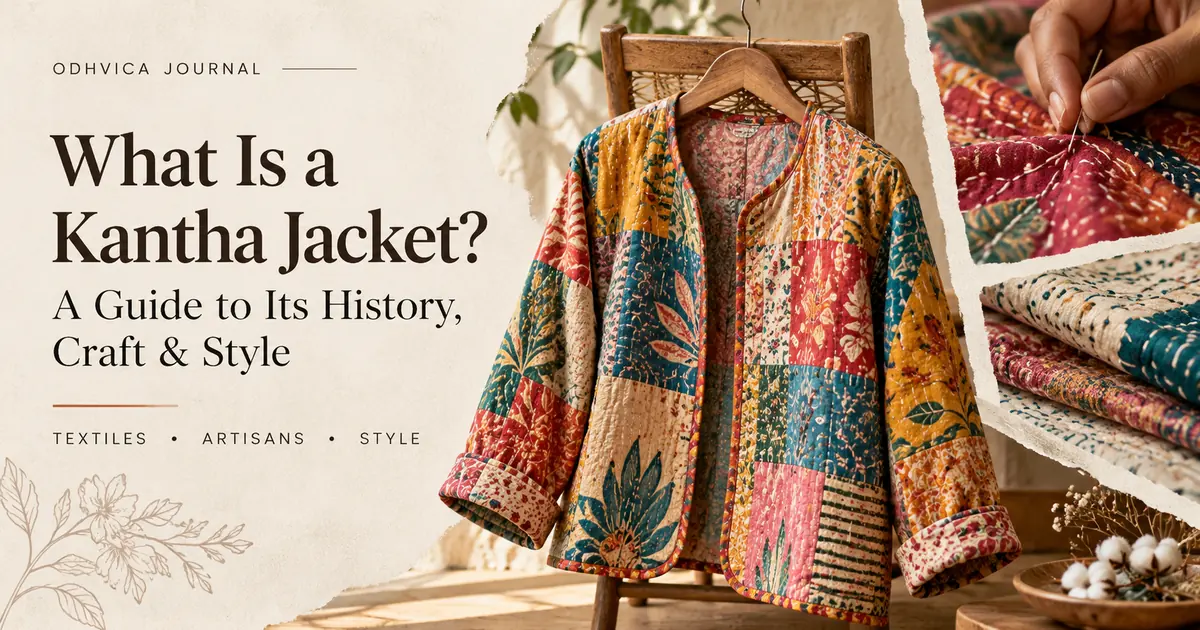
What Is a Kantha Jacket? A Guide to Its History, Craft & Style
What makes a Kantha jacket different? Explore its Bengali roots, the artisans behind the stitching, vintage versus new textiles, and practical advice on styling, sizing and care.
Look closely at a Kantha jacket and you'll notice something unusual about the fabric. Fine rows of stitching run across its surface, sometimes following the patterns beneath them, sometimes creating a texture of their own. On jackets made from older quilts, colors may have softened with age, and one side can look entirely different from the other.
Those details come from Kantha, a textile tradition rooted in Bengal, where layers of cloth were traditionally joined with running stitches to make quilts and other household textiles.
Today, Kantha appears in jackets, kimonos and other contemporary garments. But not every Kantha jacket is made the same way. Some begin with older quilts; others use newly produced fabric.
Understanding the difference can help you appreciate the craft — and choose a jacket that suits the way you actually dress.
What Exactly Is a Kantha Jacket?
A Kantha jacket is a garment made using Kantha textiles or stitching techniques associated with the traditional quilted fabrics of Bengal.
The most recognizable feature is the running stitch: small, repeated stitches that travel across layers of cloth, holding them together while creating texture on the surface.
Traditional Kantha textiles were often made from layers of previously worn fabric. Contemporary jackets may be constructed from older quilts, newly produced Kantha textiles, or fabrics inspired by the technique.
That distinction matters.
A jacket made from an older quilt may retain its original patterns, faded colors, repairs and irregularities. A newly made jacket may offer a more consistent finish or a wider choice of sizes.
Neither approach is automatically better. What matters is understanding what you're buying.
The Origins of Kantha: A Textile Tradition from Bengal
Kantha has deep roots in Bengal, a historical region now divided between Bangladesh and the Indian state of West Bengal.
Long before Kantha appeared in contemporary fashion collections, it was part of domestic textile-making traditions.
Women used layers of worn cotton cloth, including old saris and dhotis, to create quilts and other useful household textiles. Running stitches held the layers together, while more elaborate embroidery could introduce decorative motifs.
Some pieces were practical coverings. Others carried personal significance and were made for family members or important occasions.
The Philadelphia Museum of Art documents Kantha as a textile art practiced by women across Bengal. The RISD Museum also describes the reuse of worn garments and the personal meanings associated with these textiles.
The history of Kantha is therefore not simply a story about a decorative stitching technique. It is also a history of domestic skill, resourcefulness and creative expression.
The Women Behind Kantha Craftsmanship
To understand Kantha, it helps to look beyond the finished textile.
Historically, much of this work took place in homes, where women transformed familiar pieces of cloth into something useful and personal.
The materials might already have been part of family life. A worn sari could become one layer of a quilt. Threads and fabric pieces could be reused rather than discarded.
But Kantha was not only about making use of what was available.
The maker also decided how the layers would be arranged, where the stitching would travel and whether the surface would remain simple or develop into a more elaborate composition.
The repeated running stitches required patience and control. Decorative work called for an understanding of pattern, spacing and the relationship between thread and fabric.
These choices gave individual textiles their character.
It is important, however, not to treat all Kantha makers as a single anonymous group. The tradition developed across different communities and households, and individual makers brought their own knowledge and preferences to the work.
Today, contemporary Kantha clothing involves additional skills, from selecting and evaluating textiles to cutting, garment construction and finishing.
A jacket may therefore bring together work carried out at different stages and by different people.
Recognizing those contributions is part of appreciating the garment itself.
How Are Kantha Jackets Made?
There isn't one standard method used to make every Kantha jacket.
The construction depends on the fabric, the maker and the intended design.
1. Jackets Made from Older Kantha Quilts
Some contemporary jackets begin with an existing Kantha quilt.
The textile is examined, selected and cut into garment panels. Those panels are then sewn together to create the jacket's shape.
The original quilting may remain visible across the body and sleeves, while seams, pockets, closures and edge finishing are added during garment construction.
Because the starting material is an older textile, variations in color, stitching and fabric condition may be part of the finished garment.
The original quilt and the finished jacket are not the same object. The jacket is a contemporary adaptation of an earlier textile.
2. Jackets Made from Newly Produced Kantha Textiles
Other jackets use newly produced fabric featuring Kantha stitching or Kantha-style quilting.
These textiles may be stitched by hand, by machine, or through a combination of processes, depending on the manufacturer.
New production can allow for more consistent fabric availability and planned designs.
However, a newly made jacket should not automatically be described as mass-produced, just as an older textile should not automatically be assumed to be entirely handmade.
3. Garment Construction and Finishing
After the textile is prepared, it must be shaped into clothing.
Cutting, seams, binding, lining, pockets and closures all influence how a jacket looks and feels.
These details also affect durability, comfort and whether the garment can be worn on both sides.
When buying a Kantha jacket, it is worth asking not only about the fabric but also about how the finished garment was constructed.
Vintage vs New Kantha Jackets: What's the Difference?
Both vintage and newly made Kantha jackets can be appealing, but they offer different characteristics.
| Feature | Vintage Kantha Jacket | New Kantha Jacket |
|---|---|---|
| Textile | May use older quilts or fabrics | Uses newly produced materials |
| Appearance | Often varied, with signs of age | May offer more consistent colors and patterns |
| Stitching | Depends on the source textile | May be hand-stitched, machine-stitched or both |
| Condition | May include fading, repairs or wear | Generally begins with unused fabric |
| Availability | Depends on the textiles available | May be produced in repeatable designs |
| Care | Older fabrics may need extra attention | Depends on fabric and construction |
The word vintage deserves particular attention.
It does not tell you exactly how old a garment is, whether every part is original, or whether the finished jacket was made at the same time as the fabric.
A recently sewn jacket can incorporate an older textile.
If age or provenance matters to you, ask the seller what is known about the material and how the garment was made.
Are Kantha Jackets Reversible?
Some Kantha jackets are reversible, but not all.
A reversible jacket is designed to be worn with either side facing outward. This depends on more than whether the fabric has a pattern on both sides.
Look at the finishing.
Are the seams neatly enclosed? Does the jacket have a fixed lining? Are the closures suitable for wearing both ways? Do the pockets work on one side or both?
A jacket can still be reversible if its two sides have different features. What matters is whether both are intentionally finished for wear.
If the product description doesn't clearly state that a jacket is reversible, don't assume it is.
Photographs showing both sides are especially useful when shopping online.
How to Style a Kantha Jacket
One of the pleasures of a Kantha jacket is that its fabric often provides enough visual interest on its own.
You don't need an elaborate outfit to wear one.
With Jeans and a Simple Shirt
A colorful Kantha jacket works naturally over a plain cotton shirt or T-shirt and your favorite jeans.
The contrast between patterned fabric and familiar everyday clothing makes this an easy starting point.
With Relaxed Trousers
Try a shorter quilted jacket with relaxed trousers and a simple knit.
The combination is comfortable and understated, while the fabric brings color and texture.
Over a Dress
A cropped Kantha jacket can be layered over a simple dress.
Choosing a dress in one of the jacket's quieter colors creates a coordinated look without matching every detail.
As a Light Layer
Depending on its fabric and weight, a longer Kantha jacket can work as an additional layer during mild or transitional weather.
It can be worn open over a shirt or lightweight sweater.
With a Mostly Neutral Outfit
If you're drawn to a particularly colorful jacket, try wearing it with clothes you already own in black, cream, navy or other neutral shades.
There's no need to build an entirely new outfit around it.
The most useful styling advice is often the simplest: choose a piece you enjoy, then wear it in a way that feels natural to you.
What to Look for Before Buying a Kantha Jacket
A good product listing should help you understand the garment before it arrives.
Here are the details worth checking.
1. Actual Garment Measurements
Don't rely entirely on labels such as small, medium or one size.
Look for measurements of the chest, shoulders, sleeves and garment length.
Some sellers provide a flat pit-to-pit measurement, taken across the chest of a jacket laid flat.
For example, a flat chest width of 25 inches corresponds to an approximate garment chest circumference of 50 inches.
That is a garment measurement, not a recommendation about body size.
Comparing these measurements with a jacket you already own is often more useful than guessing from a size label.
2. Fabric Composition
Cotton is commonly associated with Kantha textiles, but contemporary garments may incorporate different materials.
Check the listing for the actual fabric composition rather than assuming every Kantha jacket is made from the same cloth.
3. Construction Details
Look closely at the seams, binding, closures and pockets.
These features help you understand how the jacket has been assembled and finished.
4. Vintage Fabric Condition
Older textiles may show fading, mending, uneven stitching or signs of previous use.
Some buyers appreciate these characteristics.
However, photographs should also make it possible to identify significant damage, particularly around areas that experience regular movement or stress.
5. Photographs of the Actual Garment
When shopping for vintage or individually varied textiles, detailed photographs matter.
Look for front and back views, close-ups of stitching and clear images of any notable wear.
6. Care Instructions
A vintage quilted jacket and a newly made jacket may need different care.
Read the product-specific instructions before purchasing.
7. International Shipping and Returns
If you're ordering from another country, check delivery estimates, customs duties, return eligibility and return-shipping costs.
These details are especially important when purchasing a garment with unusual sizing or an individually varied textile.
How to Care for a Kantha Jacket
There is no single cleaning method suitable for every Kantha jacket.
Care depends on the fabric, its age, dyes, stitching and garment construction.
Some manufacturers recommend gentle washing for particular garments. Others specify professional cleaning.
The safest starting point is always the care label or the seller's product-specific instructions.
Older fabrics may require additional attention, especially when their condition or colorfastness is uncertain.
If the instructions are unclear, contact the seller before cleaning the garment.
For storage, keep the jacket in a clean, dry place away from prolonged direct sunlight.
Taking care of the textile according to its individual needs can help you enjoy it for longer.
Frequently Asked Questions
Are Kantha jackets handmade?
Some are made using hand-stitched textiles, while others incorporate machine stitching or machine-sewn garment construction. The amount of handwork varies, so check the product details.
Are Kantha jackets warm?
Warmth depends on the number of fabric layers, the materials and the garment's construction. Many cotton Kantha jackets are suitable for layering, but they should not automatically be treated as insulated winter coats.
Can you wear a Kantha jacket year-round?
That depends on the garment's weight and your local climate. Lighter jackets may work in mild weather or cooler indoor environments, while heavier styles may be more comfortable during colder seasons.
How do I know if a Kantha jacket is vintage?
Ask about the age and origin of the textile, not just the finished garment. A jacket can be newly sewn from an older quilt, and visible fading alone does not prove a particular age.
What is the difference between a Kantha jacket and a regular quilted jacket?
Kantha jackets draw on a specific textile tradition associated with Bengal and its running-stitch techniques. Other quilted jackets can use a wide range of materials, stitching patterns and insulating constructions.
A Textile Tradition in Contemporary Dress
Kantha jackets bring an older textile practice into a modern wardrobe, but no two approaches to making them are necessarily the same.
Some preserve the fabric of an earlier quilt. Others use newly produced textiles. Each involves decisions about materials, stitching, construction and how the garment will be worn.
At ODHVICA, we're drawn to the character of these textiles and the skills behind them. Our collections include vintage Kantha jackets and contemporary Kantha-inspired layers designed to become part of everyday wardrobes.
If you're exploring Kantha for the first time, begin with the details. Look at the fabric, ask how it was made and choose something you'll genuinely enjoy wearing.
Explore ODHVICA's Kantha Jackets
Explore Handcrafted Kantha & Suzani Textiles
Every piece is hand-quilted by master artisans in Rajasthan with pure cotton and heritage techniques.