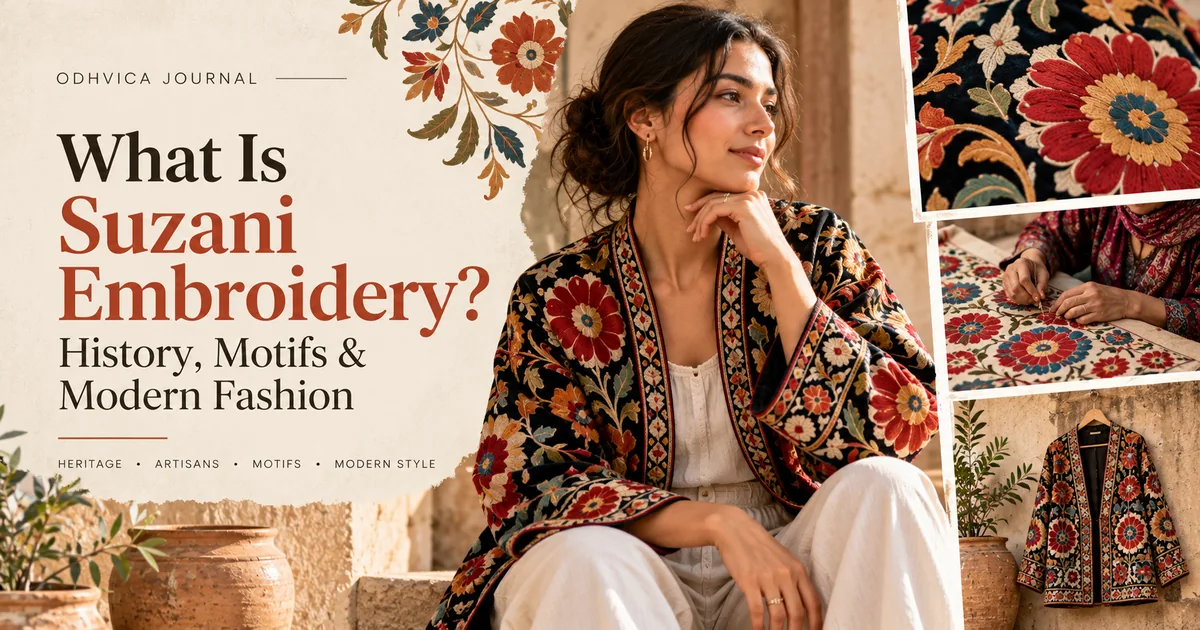
What Is Suzani Embroidery? History, Motifs & Modern Fashion
Discover the Central Asian origins of Suzani embroidery, the meaning behind its floral motifs, how the craft is practiced, and why Suzani-inspired designs appear in contemporary jackets, kimonos and everyday fashion.
Look closely at a traditional Suzani textile and the first thing you might notice is the embroidery: large flowers, curling vines, circles and leaves spreading across the cloth. Some designs are densely worked in rich reds and deep blues. Others leave generous areas of fabric visible between the motifs.
There's a remarkable amount of detail in these pieces, but the patterns aren't simply decorative. They belong to a textile tradition shaped by the people, places and households of Central Asia.
Today, Suzani designs appear far beyond the embroidered wall hangings and household textiles for which the tradition is especially well known. You'll find them on jackets, velvet coats, kimonos and accessories.
So what exactly is Suzani embroidery, where does it come from, and how can you tell the difference between a traditional textile and a modern Suzani-inspired garment?
What Is Suzani Embroidery?
Suzani is a traditional form of decorative embroidery associated with Central Asia, particularly present-day Uzbekistan and Tajikistan.
The name is commonly linked to the Persian word suzan, meaning needle.
Traditional Suzani textiles often feature large-scale embroidered patterns on cotton or silk grounds. Flowers, leaves, vines, circular medallions and other motifs may be arranged across the surface, creating designs that range from orderly and symmetrical to wonderfully varied.
Suzani is best understood as a textile tradition rather than one particular fabric or garment.
A traditional Suzani might have been made as a household furnishing or ceremonial textile. A modern Suzani jacket, by contrast, is a contemporary garment that may use an older embroidered textile, newly produced embroidery or a design inspired by historical Suzani patterns.
These differences are worth understanding, especially when shopping online.
Where Does Suzani Embroidery Come From?
Suzani is closely associated with the textile cultures of Central Asia, including cities and regions such as Bukhara, Samarkand, Nurata and Shahrisabz in present-day Uzbekistan.
The tradition also has connections with communities across neighboring parts of the region.
Surviving historical examples, particularly those from the eighteenth and nineteenth centuries, show the diversity of Suzani design. Different regional traditions developed recognizable preferences in color, composition and motif, although individual pieces do not always fit neatly into one regional category.
Historically, embroidered textiles were used in domestic settings and important family celebrations. They could serve as wall hangings, bed coverings and other household furnishings.
Some were also associated with marriage preparations and dowry traditions.
The textiles were valued not only for their appearance but also for the time, knowledge and care involved in making them.
Today, museums and textile collections preserve historical examples that help us understand the craft's artistic and cultural significance.
The Women and Artisans Behind Suzani
To appreciate Suzani, it's important to look beyond the finished embroidery.
Historically, Suzani making was closely associated with women and domestic textile production. In some communities, women prepared embroidered textiles for family use and significant life events, including weddings.
The process involved far more than following a pattern.
A maker needed to consider the size and purpose of the cloth, the arrangement of motifs, the colors of the threads and the embroidery techniques used to fill the design.
Large textiles were sometimes worked in separate panels that could be embroidered individually and joined later. On surviving examples, slight differences in pattern alignment can reveal this method of construction.
These details offer a glimpse into the human decisions behind the finished work.
Embroidery also required sustained attention. Dense areas of stitching, carefully arranged borders and repeated motifs could involve considerable time and skill.
It's tempting to describe every historical Suzani as a collective work passed down unchanged through generations. The reality is more varied. Practices differed between households, communities and periods, and the surviving textiles represent many individual approaches.
Contemporary artisans continue to work with Suzani embroidery and its visual traditions, while modern garment makers interpret the motifs in new materials and silhouettes.
Recognizing both the historical makers and today's craftspeople helps us appreciate the tradition without treating it as something frozen in the past.
What Do Suzani Patterns and Motifs Mean?
One of the most recognizable features of Suzani is its use of large, expressive motifs.
Flowers, leaves, vines, circular forms and branching designs appear frequently, sometimes arranged around a central medallion or repeated across a textile.
Certain motifs have been associated with ideas such as fertility, prosperity, protection or good fortune in particular cultural interpretations.
However, meanings are not always universal or historically documented for every design.
A circular motif, for example, should not automatically be described as a sun symbol without evidence about the particular textile.
When looking at Suzani, it helps to appreciate both its visual qualities and the cultural context in which a piece was made.
Floral and Botanical Motifs
Flowers and foliage are among Suzani's most familiar design elements.
Large blossoms, curling stems and leaves can fill the textile with movement and color.
Some compositions feature repeated floral forms, while others combine different motifs within a larger arrangement.
Circular Medallions and Rosettes
Round motifs are another prominent feature.
They may appear individually, in repeating arrangements or as part of a larger composition.
Their specific interpretation depends on the textile's origin, period and design context.
Borders and Repeating Patterns
Many Suzani textiles use embroidered borders to frame the central design.
These borders can create a sense of structure even when the interior composition is highly expressive.
Looking closely at the relationship between the border and the main motifs is one way to appreciate the maker's design choices.
How Is Traditional Suzani Embroidery Made?
Traditional Suzani embroidery involves preparing a fabric ground, developing a design and stitching the motifs onto the textile.
The exact materials and techniques vary by region, period and maker.
Choosing the Fabric
Historical examples commonly use cotton or silk grounds, sometimes assembled from multiple fabric widths.
The material provides the surface on which the embroidery is worked.
Preparing the Design
Motifs are arranged across the fabric before or during embroidery.
Large compositions may include central elements, surrounding floral forms and decorative borders.
Embroidering the Motifs
Suzani textiles are associated with several embroidery techniques, including forms of couching and chain stitching, although not every piece uses the same stitches.
The chosen techniques influence the density, texture and appearance of the finished design.
Joining and Finishing
Some large historical Suzani textiles were embroidered in separate sections and sewn together afterward.
Small irregularities in the alignment of motifs can be evidence of this construction method.
These variations should be understood in context rather than treated automatically as defects.
Traditional Suzani vs Modern Suzani-Inspired Clothing
Not every garment described as “Suzani” is made from a historical Suzani textile.
The word may be used for different types of contemporary products.
| Feature | Traditional Suzani Textile | Modern Suzani-Inspired Garment |
|---|---|---|
| Original purpose | Often household or ceremonial use | Designed as wearable clothing |
| Materials | Historically often cotton or silk grounds | May use velvet, cotton, silk or other fabrics |
| Decoration | Embroidery using traditional techniques | May be hand embroidery, machine embroidery or printed motifs |
| Construction | Textile furnishing or decorative panel | Tailored into a jacket, kimono, coat or other garment |
| Age | Depends on the individual textile | May be newly produced |
| Provenance | May be linked to a region or maker | Depends on manufacturer and product documentation |
A newly produced velvet jacket with floral embroidery can be inspired by Suzani without being an antique or a traditional household textile.
That doesn't automatically make it less appealing. It simply means the product should be described accurately.
For buyers, the important questions are whether the decoration is embroidered or printed, what fabric is used, how the garment is constructed and what information is available about its production.
Why Is Suzani Embroidery Often Seen on Velvet Jackets?
Velvet provides a visually rich surface for embroidered motifs.
Its pile catches the light differently depending on the angle, creating subtle changes in tone. Decorative stitching can stand out against that surface, particularly when the embroidery uses contrasting colors.
This combination is one reason Suzani-inspired motifs work well on contemporary jackets and long outer layers.
But a velvet Suzani jacket isn't a single standardized type of garment.
Some designs feature dense embroidery across much of the fabric. Others concentrate decoration around the front panels, sleeves or borders.
Construction and fabric composition also vary.
When buying a velvet jacket, check whether the decoration is embroidered or printed and whether the velvet is made from cotton, silk, synthetic fibers or a blend.
These details can influence appearance, feel and care requirements.
How to Style a Suzani Jacket
A Suzani-inspired jacket often has enough color and detail to become the focal point of an outfit.
That doesn't mean it needs to be saved for special occasions.
With Jeans and a Plain Shirt
A richly embroidered jacket works naturally with denim and a simple cotton shirt.
The contrast between decorative fabric and everyday basics makes the outfit feel relaxed.
Over a Simple Dress
A long embroidered velvet layer can be worn over a plain dress for an evening out or a special gathering.
Choose colors you enjoy rather than trying to match every shade in the embroidery.
With Neutral Trousers
Cream, black, navy or brown trousers can provide a quiet backdrop for detailed embroidery.
This is an easy way to wear a colorful jacket without adding more patterns.
As an Occasion Layer
An embroidered jacket can also work over a simple outfit for a dinner, celebration or event.
The fabric provides much of the visual interest, so the rest of the clothing can remain uncomplicated.
With Your Everyday Wardrobe
Perhaps the most useful approach is to begin with what you already wear.
If you usually choose jeans, start there. If you prefer dresses or relaxed trousers, try the jacket with those instead.
A distinctive textile doesn't need an entirely new wardrobe around it.
What to Look for When Buying a Suzani Jacket
When shopping online, the product photographs are a useful starting point, but they shouldn't be the only source of information.
Check Whether the Design Is Embroidered
A floral pattern can be created through hand embroidery, machine embroidery, printing or other decorative methods.
If the technique matters to you, look for a clear explanation in the product description.
Look at the Fabric Composition
Not all velvet is made from the same fibers.
Cotton velvet, silk velvet and synthetic velvet can have different characteristics and care requirements.
Review the Measurements
Compare the actual chest, shoulder, sleeve and length measurements with a similar garment you own.
A label such as “one size” doesn't tell you everything about the fit.
Examine the Finishing
Look for clear photographs of the seams, lining, edges and closures.
These details can help you understand how the garment is constructed.
Read the Care Instructions
Embroidery and velvet may require careful cleaning and storage.
Always follow the garment-specific instructions rather than assuming one method is suitable for every piece.
Understand Shipping and Returns
For international orders, check shipping destinations, estimated delivery times, import duties and the return policy before purchasing.
How to Care for Suzani Embroidery and Velvet Clothing
Care depends on the fabric, embroidery threads, dyes and garment construction.
Traditional embroidered textiles and contemporary velvet garments may require different approaches.
Start with the care label or the seller's product-specific guidance.
Avoid rubbing embroidered areas or using an unverified cleaning method.
If the fabric is delicate, valuable or of uncertain composition, seek advice from a qualified textile-care professional.
Store garments in a clean, dry environment and avoid prolonged exposure to direct sunlight.
For historical or collectible Suzani textiles, conservation advice may differ substantially from ordinary clothing care.
Frequently Asked Questions About Suzani
Is Suzani embroidery Indian or Central Asian?
Suzani is historically associated with Central Asia, particularly regions of present-day Uzbekistan and Tajikistan. Suzani-inspired garments may be designed or produced in other countries, including India.
Is all Suzani embroidery handmade?
No. Traditional Suzani textiles are associated with hand embroidery, but modern Suzani-inspired products may feature hand embroidery, machine embroidery or printed patterns. Check the individual product description.
What are common Suzani motifs?
Floral designs, leaves, vines, circular medallions and decorative borders are common. Motif arrangements and interpretations vary across regions and individual textiles.
What is a Suzani jacket?
A Suzani jacket is a contemporary garment featuring Suzani embroidery or Suzani-inspired decorative patterns. It may be made from velvet, cotton or other materials, depending on the design.
Are Suzani jackets suitable for everyday wear?
Some are, depending on their fabric, construction and care requirements. A lightweight jacket may work as a casual layer, while a more elaborate velvet design may be better suited to particular occasions.
What is the difference between Suzani and Kantha?
Suzani is a Central Asian decorative embroidery tradition known for large motifs and ornamental compositions. Kantha is a textile tradition associated with Bengal, often using running stitches across layered fabrics. Their origins and traditional techniques are distinct.
The Craft Behind the Pattern
Suzani's appeal goes beyond its bold flowers and elaborate embroidery.
The tradition reflects the knowledge of makers who understood how to work with fabric, thread, color and composition. Historical examples preserve evidence of that skill, while contemporary garments show how the visual language of Suzani continues to be interpreted.
At ODHVICA, we're drawn to the character of embroidered textiles and the way they can become part of modern wardrobes.
Our Velvet Suzani Jacket and Velvet Long Kimono collections explore decorative textile styles in wearable forms.
Whether you're interested in the history or simply drawn to the color and pattern, understanding the craft offers another way to appreciate the clothing.
Explore ODHVICA's Suzani Collection
Explore Handcrafted Kantha & Suzani Textiles
Every piece is hand-quilted by master artisans in Rajasthan with pure cotton and heritage techniques.